Where is the door catching?
The order below is the one the technician works at the house. It is not a list of things to do yourself: the vertical tracks live right next to the lift cables and bottom brackets, which carry their highest spring tension with the door closed.
1. Door closed, opener unplugged
Every track check starts with the door down and the opener disconnected at the ceiling outlet. A closed door is also where the vertical tracks carry no roller load, so a loose bracket or a bent section is easier to see from the floor.
2. Sighting down each vertical track for dents and bends
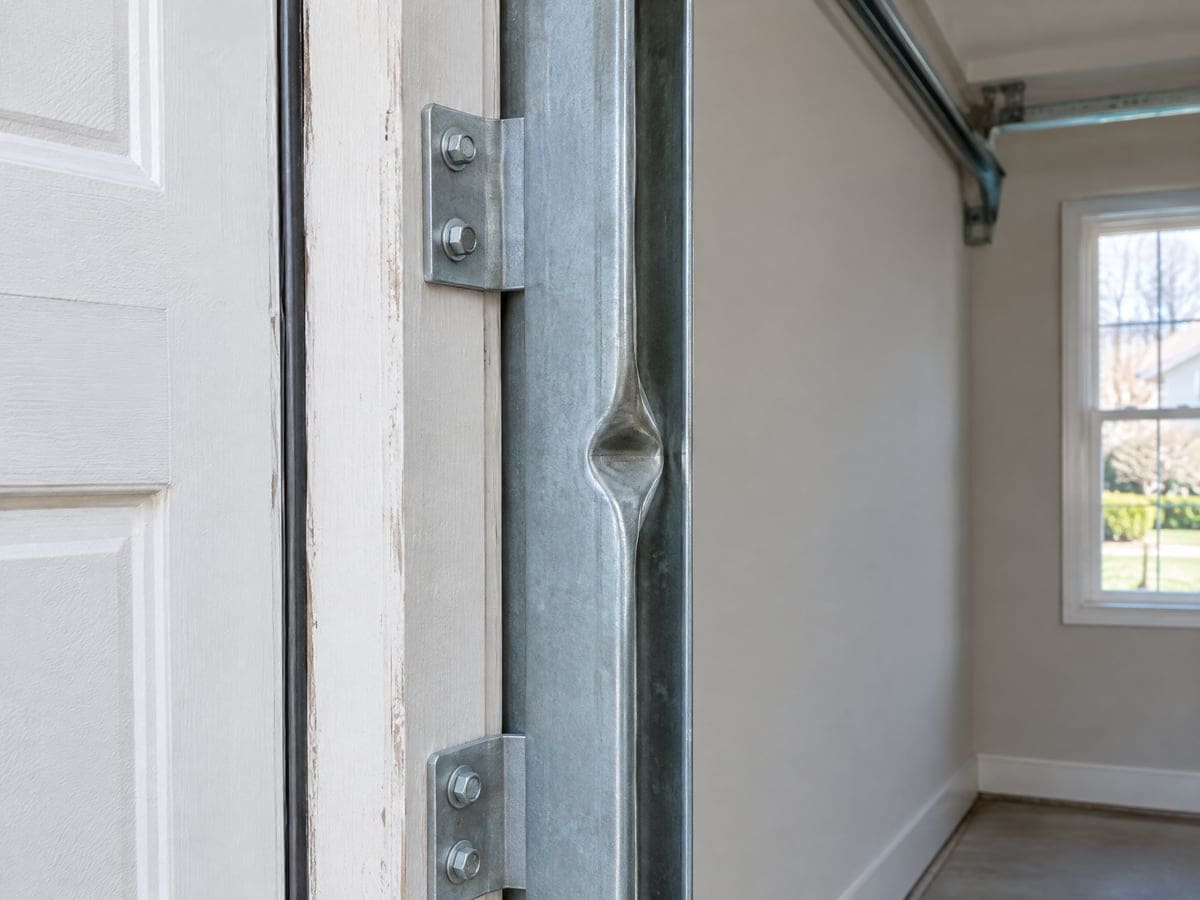
The technician stands at the floor and sights up each vertical track like sighting a shotgun barrel: it should be straight from the floor to the curve. A dent from a bumper, a bulge from a bike leaning on the track, or a bow from an unsupported bracket is visible as a kink in that straight line. The dent at the height the door catches is almost always the one.
3. The gap between roller and track
A good roller sits with a small, even gap between the wheel and the back of the track. A roller pinched hard enough to bind, or loose enough to walk out of the track at the curve, is a track that has moved. The technician checks each roller against the back of its track at closed, halfway and open positions.
4. Jamb brackets and lag screws
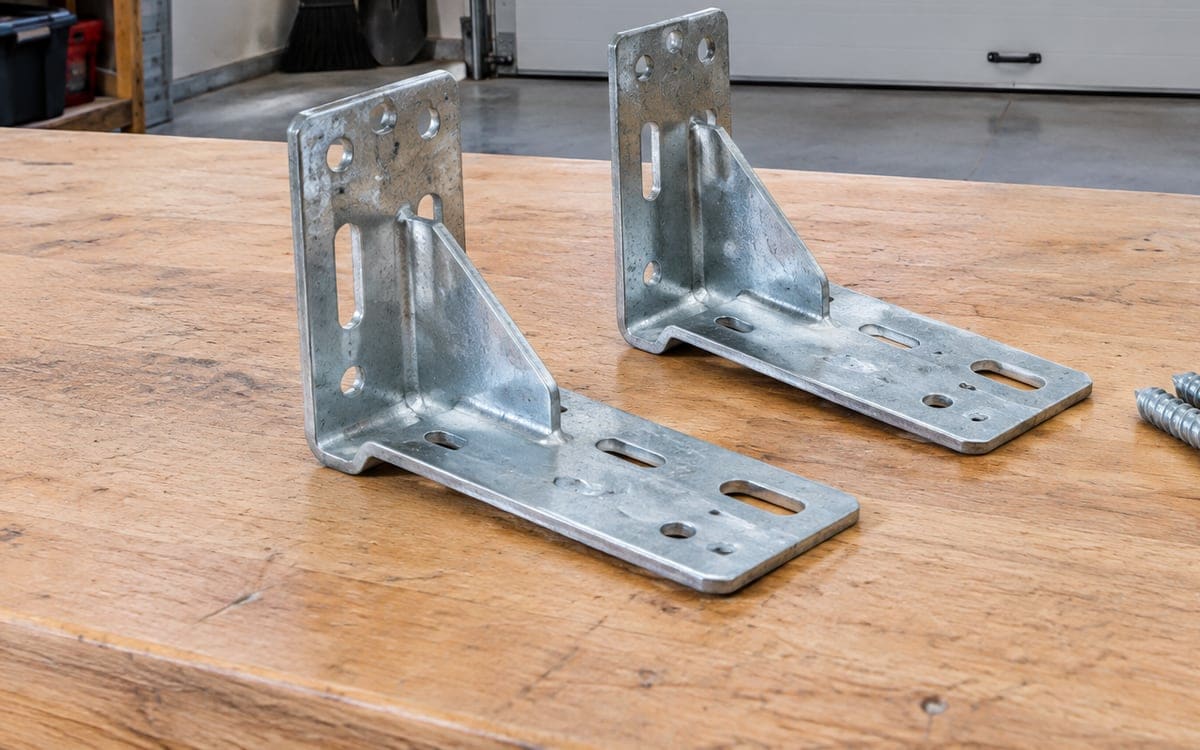
Each vertical track is bolted to a jamb bracket, which is lag-screwed into the wood of the opening. A loose lag that has pulled a quarter inch out of the jamb is enough to move the whole track and bind the roller halfway up. On older framing the lag may have been in soft spruce or in wood that has split; the fix is a longer lag, a stronger bracket, or in bad cases a new piece of wood blocking behind the bracket.
5. Horizontal tracks and the rear hangers
The horizontal tracks are hung from the ceiling with angle iron and lag screws. A hanger that has worked loose lets the horizontal track sag and pulls the vertical track out of plumb at the curve. The technician checks each hanger for play and for the right height, and resets what has moved.
6. Rust at the foot of the vertical tracks
Road salt and water collect in the bottom few inches of the vertical track, where the roller sits when the door is down. On older doors the steel at that height is sometimes rust-flaking enough that a new section is a better fix than a straightened one. The track at the floor is also where a sloppy snow shovel has, more than once, caught the inside corner.
The symptom table
| Symptom | Likely cause | What it usually needs |
|---|---|---|
| Door catches at the same height every time | Dented or bent vertical track at that height | Straighten or replace that section |
| Uneven roller gap along the track | Track moved in its brackets, or roller stem bent | Reseat the track, rollers that bind checked |
| Loose jamb bracket, visible gap at the lag screw | Lag has worked out of the wood, or framing is soft | New longer lag or stronger bracket; blocking if needed |
| Horizontal track sagging at the rear | Rear hanger worked loose | Reset the hanger and realign the track |
| Rust at the foot of the vertical track | Years of road salt and apron slush | Replace the lower section, or the full vertical |
Repair or replace
Most tracks are repaired on the opening they stand in. We pull a dent straight so the roller runs through again, reseat a loose jamb bracket, and adjust a sagging rear hanger from the ceiling.
A section is replaced when the dent has creased the steel, when the track has rust-flaked through at the foot, when a bend has stressed the steel enough that it will not stay straight after a pull, or when a bracket has torn out and left no good wood to re-lag into. A full new track pair is the right call on an older door where both sides have gone soft at the floor. A section bent by the same bump is a related call: a car that bumped the track usually bumped a section too.
What a technician brings
A track visit usually needs vertical and horizontal track in common lengths, jamb brackets in the common hole patterns, rear hangers, lag screws in a couple of lengths and gauges, and the kind of body-work tools that pull a dent out of thin steel without creasing it. A door with an unusual track height, a non-standard track thickness, or an opening with soft wood that needs new blocking may need a return visit with the right materials.