What is making the door grind?
The checks below are what the technician does at the house, with the opener disconnected and the door run slowly by hand. That slow run is safe only on a spring-balanced door, so the technician does it rather than the homeowner.
1. Watching the door run
A door with worn rollers moves differently on the way up and the way down. The technician watches a slow pass and notes where the shudder is: top of the stroke, bottom of the stroke, or at the transition from vertical to horizontal track. A roller that only chatters where the track curves is a different fault than a roller that is loud all the way up.
2. Flat spots, cracked wheels and bent stems
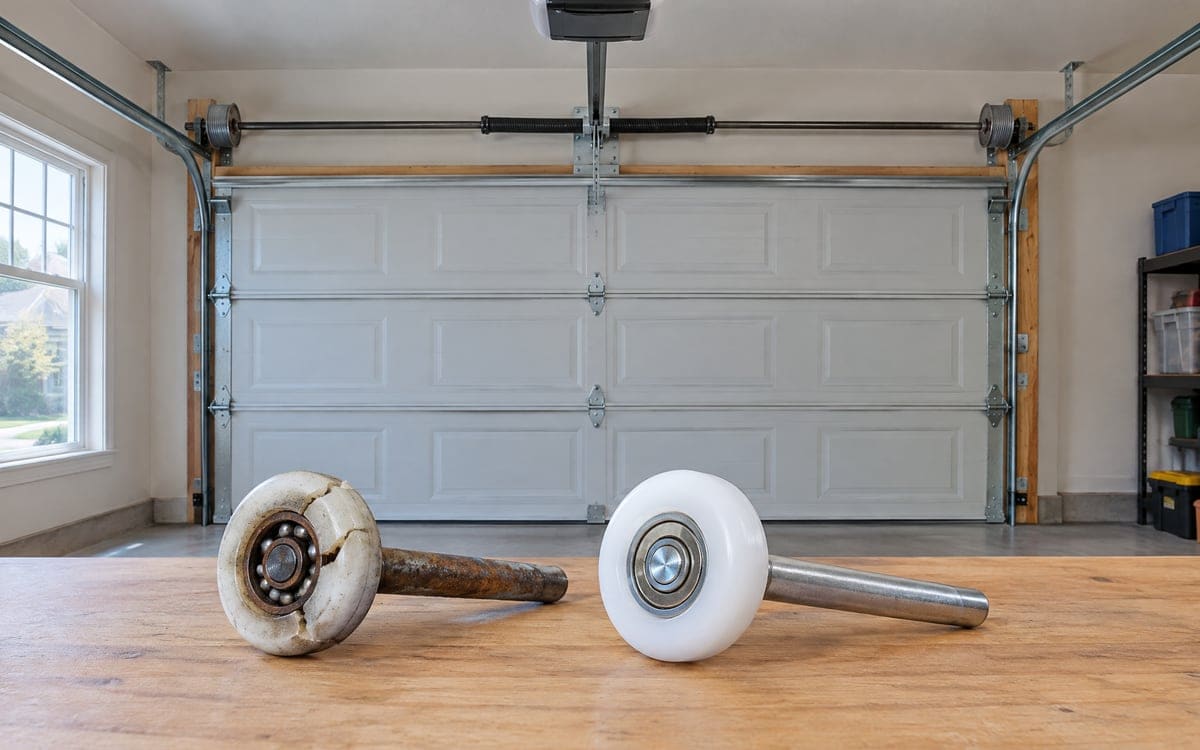
A worn roller shows one of three patterns. A plastic wheel develops flat spots where the roller stopped carrying weight; the door then clicks once a revolution. A sealed-bearing roller with a seized bearing drags instead of rolling, and polishes a shine onto the inside of the track. A bent stem makes the wheel ride against the side of the track and squeal.
3. The hinges that carry the rollers
Every roller except the bottom one lives in a hinge between two sections. A worn hinge sloppy enough to let the roller walk sideways is a hinge that will crack at the knuckle inside a season. The technician checks each hinge for cracks and loose screws and replaces any that are at the end of their life while the door is open on the hinge side.
4. Listening along the tracks
The technician listens for the pitch and location of each squeak or chatter on a slow pass, then runs a hand along the inside of the vertical track (with the door closed) and feels for grooves where a bearing has given up and the stem has scored the steel. A deep groove in the track means that section may need to be replaced while the roller is out.
5. The bottom roller brackets, which hold spring tension
The roller at each bottom corner lives in a bracket that also anchors the lift cable. The bottom bracket is under full spring tension at the door's lower corner and is never a homeowner job. The technician changes a bottom roller with the spring unloaded and the cable managed, not with a wrench in the garage.
A short vocabulary
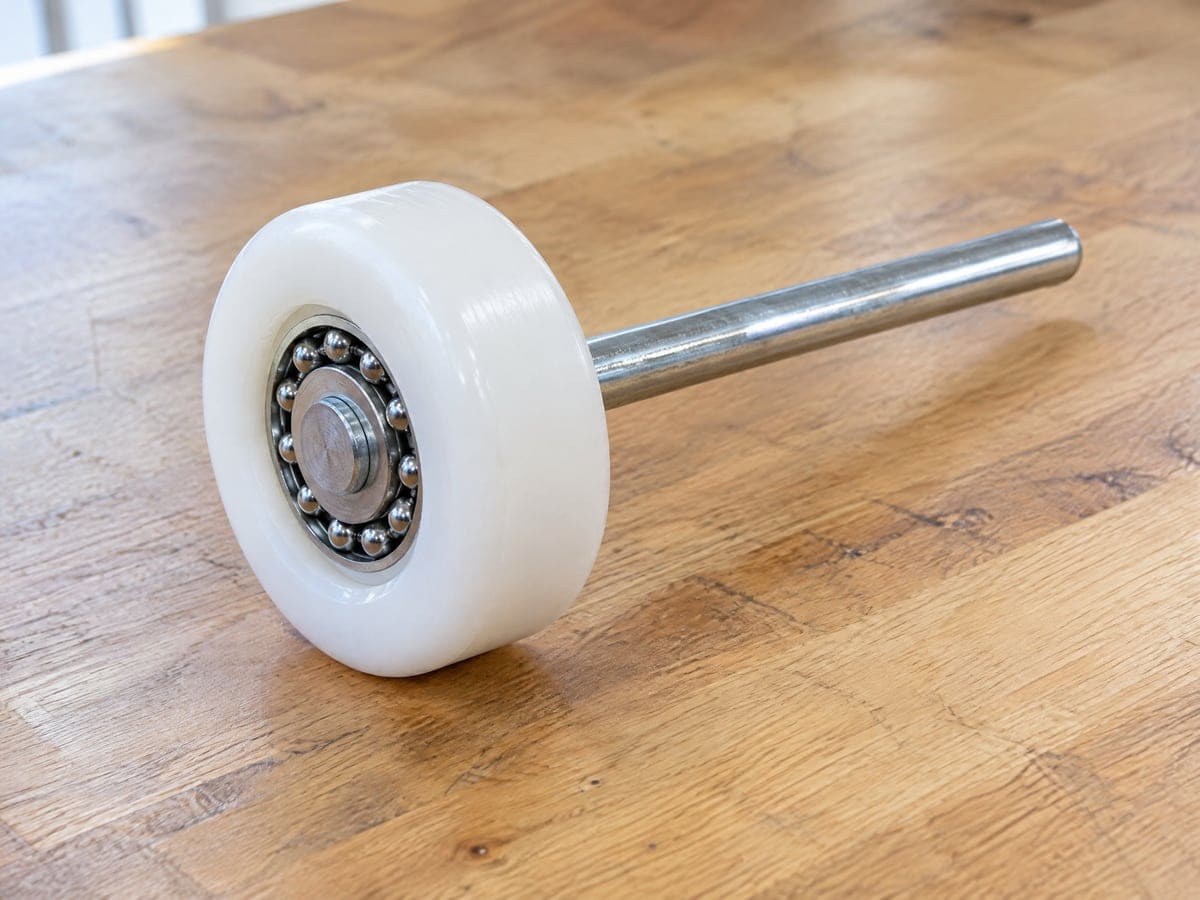
- Nylon roller: a plastic wheel on a steel stem. Quietest, with a sealed bearing on the better versions.
- Steel roller: an all-metal wheel on a steel stem. Loudest, longest-lived, used where quiet is not the priority.
- Sealed bearing: a ball bearing enclosed against dust. The feature that keeps a good roller good through a few winters of apron slush.
- Stem: the steel rod the wheel spins on. A bent stem will not run true.
- Hinge number: the number stamped on each hinge (1, 2, 3) that tells where it goes in the stack.
The symptom table
| Symptom | Likely cause | What it usually needs |
|---|---|---|
| Grinding on every pass | Flat spots or failed bearings | Full set of rollers |
| Door wobbles sideways in the track | Bent stems or sloppy hinges | Rollers plus the hinges that carry them |
| Flat spot clicks once a revolution | Plastic wheel that stopped rolling for a while | Replacement roller at that position, usually the full set |
| Rust bleeding out of the bearing | Water in the sealed bearing, usually from apron slush | Set of rollers with sealed bearings |
| Door jumps in the track at the curve | A roller riding the side of the track at the transition | Rollers plus a look at the track the rollers ride in |
Repair or replace
A worn roller gets a new roller. A sealed bearing cannot be opened and repacked, and a bent stem does not go back to straight. A full set is the usual job because the rollers were installed together and have lived the same cycles. On a door whose hinges and track have worn with the rollers, the price covers all three.
A new door comes up only when the roller job is part of a longer list the door has already lost: sections cracked at the hinge line, tracks past straightening, panels bent and no match available. On a sound door with worn rollers, the fix is the rollers.
What a technician brings
A roller visit usually needs nylon and steel rollers in the common stem sizes, a selection of hinge sets with the position numbers that match the stack, bottom brackets, lubricant for the hinges, and a cordless impact for the track bolts. A door with an unusual roller (very long stems, non-standard wheel size) may need a return visit with the right part ordered in.