Plows roll at two inches
Hoffman Estates Public Works starts plowing when two inches or more of snow has accumulated, based on reports from O'Hare Airport, and plows major streets first, then side streets and cul-de-sacs.2 A storm that drops a two-inch snowfall triggers a full operation across the village's main network before the side streets get touched.
Early 2025 took 2,700 tons
From January to April 2025, Public Works ran 19 snow and ice response operations using 2,700 tons of salt and 16,000 gallons of chemical pre-treatment, and took delivery of over 2,800 tons of road salt and 17,500 gallons of de-icing liquid.1 Nineteen operations in four months is roughly one event a week across the back end of winter, each one laying salt across the village's network.
Hoffman Estates salt, January to April 2025
Village Public Works, January to April 2025, from the Village's 2026 budget.
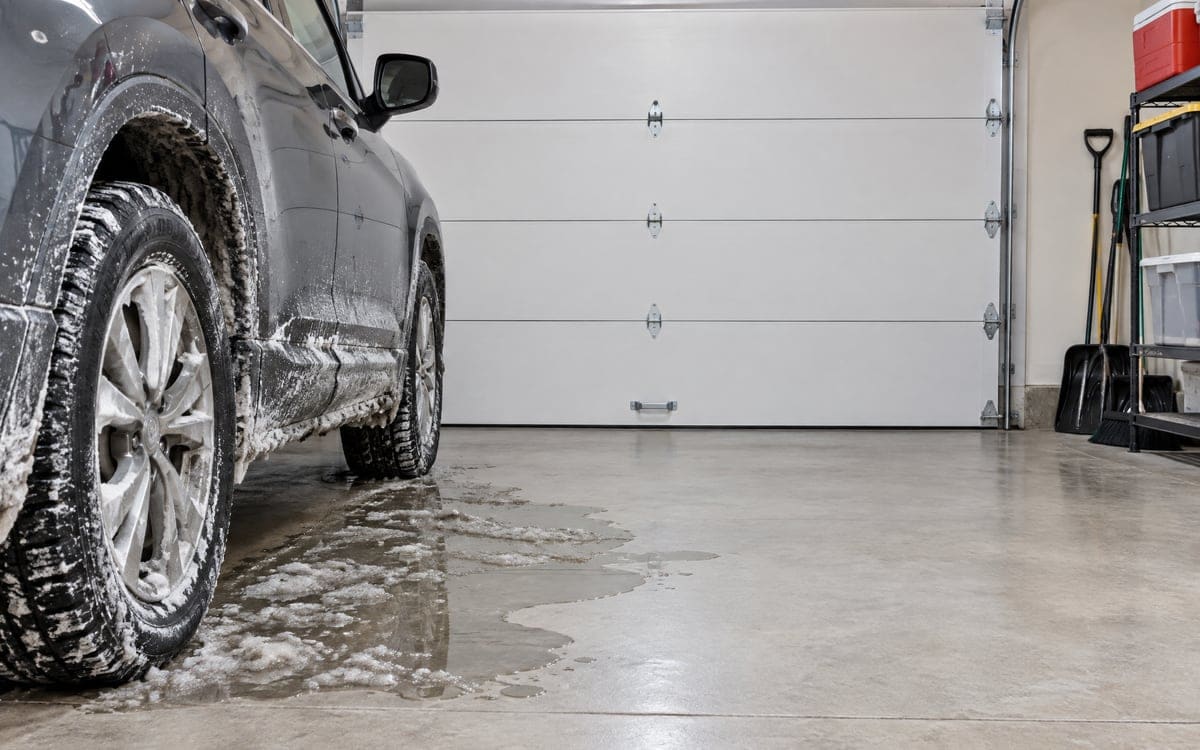
That is a lot of salt. On a car that lives inside a garage, it rides home on the tires and the wheel wells, dries into a crust in the warmth of an attached garage, and settles out on the floor. On a shovel pushed back to the garage apron, it leaves a gray ring on the concrete.
Cul-de-sacs and side streets come after the main roads
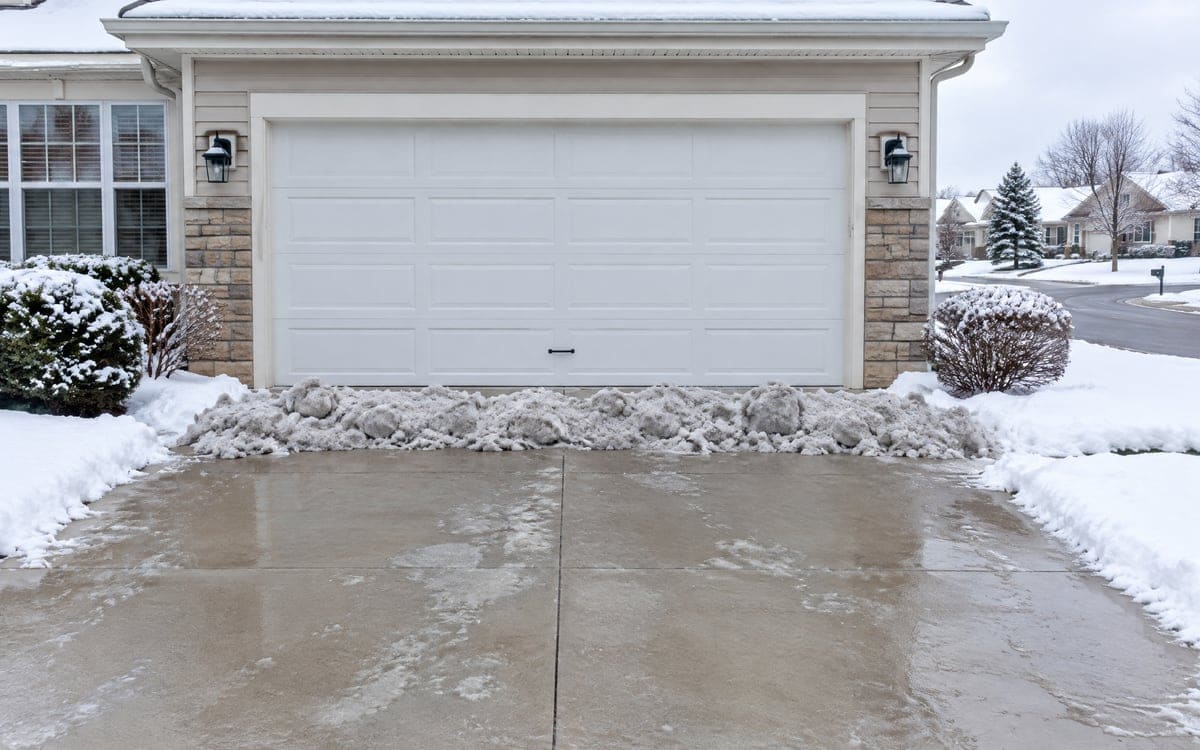
The Snow and Ice Control Division handles 161 center-lane miles of roadway and more than 360 cul-de-sacs with 50 full-time drivers and four mechanics, and lists reducing salt usage as a performance goal.1 Houses on a cul-de-sac or a side street may see snow piled at the end of their drive hours after the main roads were cleared. The ridge that the plow leaves at the mouth of the driveway sits there long enough to melt, refreeze and leach salt into the asphalt and concrete.
For a homeowner, that mouth of the driveway is where the salt lingers longest. For a garage door, that is also where the car sits before it rolls the last few feet into the garage.
State and county crews plow the big roads
Not every road around a Hoffman Estates home is a Village road. IDOT plows Higgins Road (Route 72) and Sutton Road (Route 59),3 among others, and the Cook County Highway Department handles Shoe Factory Road, Plum Grove Road, Central Road, Ela Road and Bode Road.3
State and county roads around the village
IDOT and the Cook County Highway Department plow these routes.
IDOT
- Higgins Road (Route 72)
- Golf Road (Route 58)
- Algonquin Road (Route 62)
- Sutton Road (Route 59)
- Barrington Road
- Palatine Road
Cook County Highway Department
- Roselle Road
- Schaumburg Road
- Plum Grove Road
- Shoe Factory Road
- Central Road
- Bartlett Road
- Ela Road
- Bode Road between Barrington Road and North Sutton Road
Source: Village of Hoffman Estates, Winter road issues: Know who to call.
That matters because the plow timing and the responsible crew on a state or county route differ from the Village's, but the end result is the same for the car. The driver takes a state-cleared road to a county-cleared connector to a Village street, picks up slush and salt residue on each, and drives home.
The car carries the rest into the garage
Salt reaches a garage door in two ways: on tires and on shoes. In an attached garage with a drain or a sloped slab, the melt flows out. In a flat garage, it pools against the lowest edge, which is often the seam between the slab and the bottom of the door.
The normal first measurable snowfall (0.1 inch or more) at Chicago O'Hare comes on November 18 and the normal last on April 2.4 Call that four and a half months where salted slush is a regular visitor to the garage.
| Where salt enters | What it reaches on the door |
|---|---|
| The ridge the plow leaves at the drive mouth | Tires, then the garage floor as the car parks |
| The salted apron where the car stops | The bottom seal, the bottom section, the bottom corner brackets |
| Shoes and boots walking in | The slab, then the lower track at both sides |
| The sidewalk salt a homeowner spreads | The threshold, then the retainer that holds the bottom seal |
Slush settles at the foot of the door
The first few inches of a garage door live in a different climate than the top. Water pools at the slab, salt crystals dry out there, and grit from the street collects in the same spot. A door that is in good shape higher up often shows its first signs of trouble at the bottom corners.
A quick test from outside: close the door, step back and look at the bottom corners from the driveway. A line of daylight at a corner is a bottom seal that is torn or a slab that has settled. From inside, look at the inside face of the bottom section with the door down. Streaks of orange on the inside of a steel door are rust working through the paint from the bottom edge up.
Cables and bottom brackets
The two parts that sit near the floor and matter most for safety are the lift cables and the bottom brackets. The lift cables run from a drum at the top of the door down each side and attach at the bottom bracket on each corner. With the door closed, the lift cables are under full tension from the springs. Everything that holds the door up is pulling against those two fixtures.
Neither part is a homeowner job. The bottom bracket stays under spring tension at all times when the door is closed. Cable and bottom bracket repair is the technician's work.
The bottom seal and its retainer go next
The bottom seal is the rubber strip that squeezes against the slab when the door closes. The retainer is the aluminum or steel channel that holds the seal into the bottom section. Salt gets into both.
A seal that has flattened, torn or come loose from a corner lets slush right under the door. A rusted retainer is a slower problem, because the channel is harder to see, but it is the one that often decides whether a new seal can be fitted or the retainer has to be replaced too. A new bottom seal and retainer is one of the smaller services on the list.
The rollers and the track at the foot of the door are the next layer. Rusted rollers are often found during the same visit as a seal replacement, and the inside of the lower track takes track rust at the floor first.
Rinse after the last snow, never spray the springs
A good routine for an attached garage is a hose rinse after the last snow of the week. Rinse the floor, the slab at the threshold and the lower face of the door. Keep the water off the springs, the opener and the circuit panels. Water on a spring does nothing to clean it and may push salt into the coils; water on an opener head is a problem of a different kind.
A soft push-broom with warm water is the right tool for the door face. A pressure washer is a bad idea; it drives water past seals that were doing their job before the hose showed up and strips paint off steel sections that would last another winter undisturbed.
The things homeowners should not touch to clean salt off: the springs, the cables, the drums, the bottom brackets, the opener head. All of those stay with a technician.
Rust that means replace, not clean
Some rust means a failed part. A cable with visible fraying, a bottom bracket with a hole through the metal or deep pitting, a roller with a cracked wheel or a bearing that no longer turns, and a bottom section with holes through it all point to replacement rather than cleaning.
A technician reads whether the metal underneath is sound. Nothing about a cable, a bottom bracket or the spring hardware is a homeowner cleaning job.
Winter does more than one thing to a garage door. Winter and springs covers the other half. For a homeowner routine that catches salt damage early, a monthly look at the hardware is the companion piece.