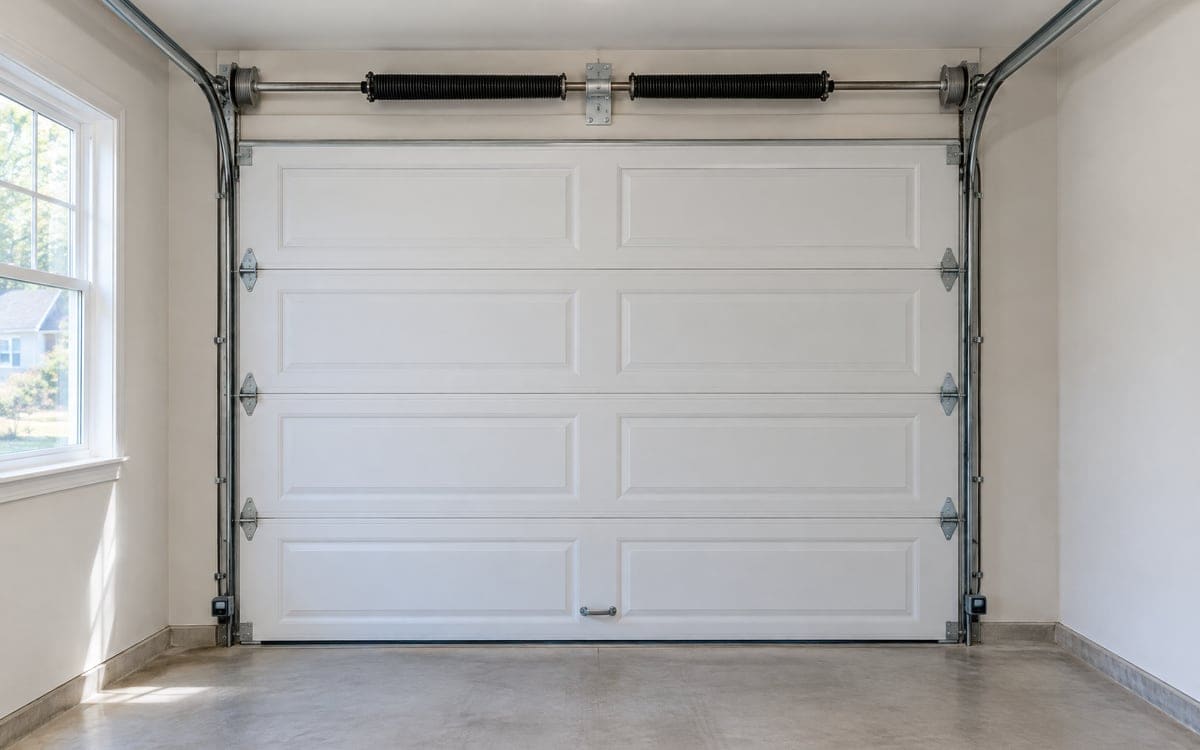
A wound spring stores enough force to injure
A torsion spring above the opening sits wound at rest, carrying the most tension when the door is closed and the full weight of the door is hanging from the cables. Even with no opener running, the spring is loaded, and the only thing holding that load is a pair of set screws clamped onto a steel shaft. Loosen those screws without the right winding bars and the spring unwinds through whatever is in the way, which may be a wrench, a hand or a face.
An extension spring is loaded differently, stretched along the ceiling track, but the stored energy is the same order. A spring that lets go can send a shaft fitting across the garage at the speed of a thrown hammer. Broken fingers, lacerations and chipped bone are the usual results.
What garage door spring tension actually does, and why a technician sets it
The springs carry the door's weight so the opener does not have to. With the springs balanced for the door, the opener only has to overcome friction, and the door moves smoothly in both directions. With the springs weak or wrong, the opener has to make up the difference every stroke; the chain or belt whips and the motor runs hot.
Checking which one is happening, and setting the spring to match, is the technician's work on a visit. If the door is behaving badly and the goal is to stop the opener running until that visit, turn off the breaker to the opener at the electrical panel. Do not pull the emergency release, since the door can drop under its own weight once it is off the opener.
Torsion and extension springs hold tension differently
A torsion system uses one or two springs wound on a shaft above the opening. The number of turns on the spring sets the tension. More turns means more lift. Each spring is sized for a certain door weight and height, and the sizing comes off the manufacturer's chart rather than from a guess by feel. The wrong spring on the wrong door can balance the door for a few weeks, then wear itself out early.
An extension system uses two springs that stretch when the door closes and pull cables when the door opens. The two springs have to be matched, or the door hangs crooked. Garage door extension springs on a 1970s door covers that system in more depth.
The wrong spring makes it worse later
A spring that is the wrong size for the door is a slower kind of trouble. It balances the door for a few weeks, then weakens as it works outside its range. By the time the door starts drooping, the opener has already taken the extra strain for weeks, and a balance that looked right during installation turns into a cable job and an opener call later on. Winding a torsion spring is a job for a technician with the right tools; a homeowner has no safe way to do it.
Cables and drums are under the same tension
The cables that lift the door run from the two bottom brackets at the lower corners of the door, up the side of the opening, and onto a drum at each end of the torsion shaft. Those cables carry the full load the spring is holding. The bottom brackets are bolted on with that tension locked across them, which is why the brackets have tamper-resistant hardware and a label that says do not loosen.
If a cable is loose, the drum is wrong or the bracket is backed off, the balance work on the spring will not hold. Our cable and drum repair covers the parts on either end of the shaft, and cables are worth checking whenever the springs are being worked on.
The door tells you when tension is off
The signs are visible from the floor, so you do not need a ladder:
- The door hangs lower on one side than the other when closed.
- Under the opener, the door drops faster than usual, or stalls halfway up.
- A spring looks parted, with a gap of a few inches in the coil.
- The opener strains at the start of a lift, then runs normal, then strains again at the top.
- The door makes a flat bang at the bottom instead of a soft bump.
| Symptom | What it means | What we do |
|---|---|---|
| Door closes faster than usual, slams at the floor | Spring undersized or worn | Replace with correctly sized springs |
| Opener races on the way up, door rises fast | Too much tension | Technician sets tension to the door's weight |
| Door hangs crooked when closed | Mismatched springs or cables | Match a pair, replace cables if needed |
| Opener strains, chain whips | Door too heavy for the spring | Weigh the door, size correctly |
| Loud bang from garage, nobody home | Spring broke | Replace both springs together |
A door that behaves this way wears its opener out faster every cycle, and once a spring snaps the door comes down with it.
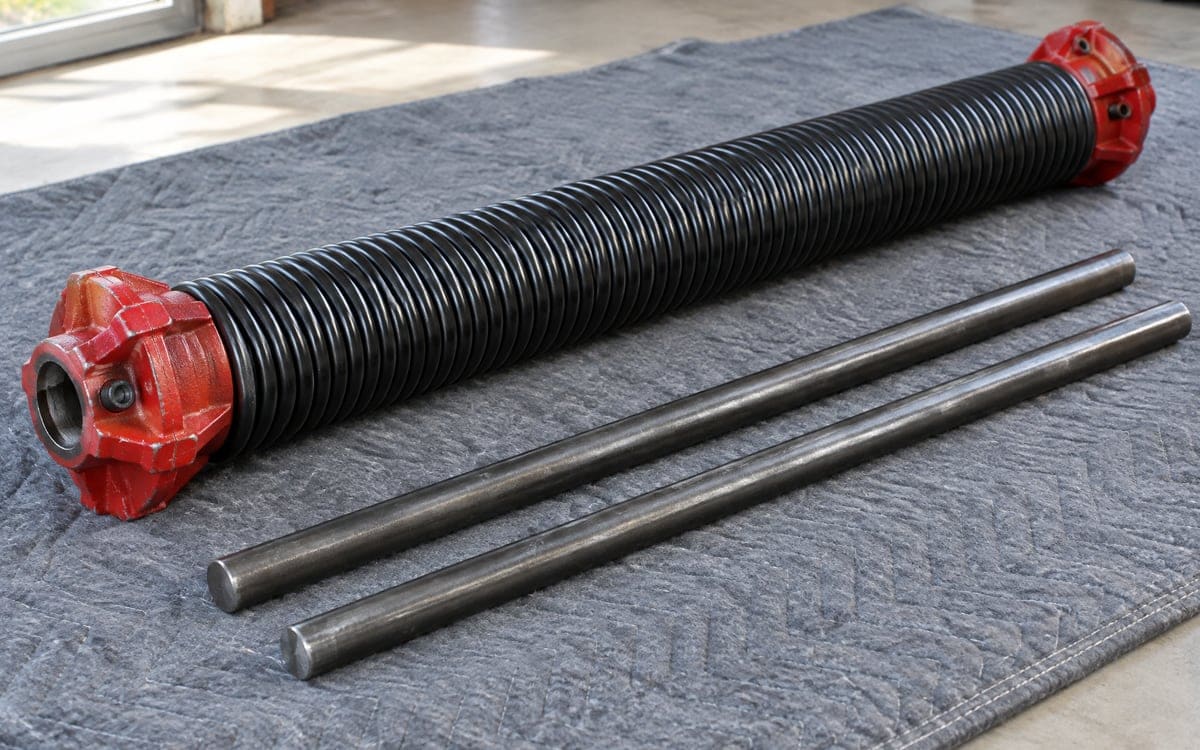
What a spring visit covers
A spring visit looks at the door's weight, the spring that matches that weight, and the hardware that carries the lift at the ends of the shaft. Both springs on a two-spring door are replaced together, so the pair stays matched. Cables that are suspect get replaced while the shaft is apart. The balance gets set to the door, and a full open-and-close cycle is run before the opener comes back on.
Our garage door spring repair covers the full job. Emergency garage door repair is where to go when a spring snaps with the car inside. The freeze season is covered in garage door springs and the freeze season.
Why a weekend try usually ends with a call anyway
Spring work goes wrong in a few predictable ways. A homeowner pulls the emergency release and drops the door onto a shin, bending panels. Someone else winds the spring with a screwdriver, loses the cone, and the spring unwinds through a hand. A third buys a spring online sized for a lighter door, installs it, and the opener burns out a few months later.
Any of those costs more to put right than the original job would have. If the spring is making noises or a bang has already happened, call before ordering parts. Call (847) 744-8615 and tell us the age of the door, how it sounds, and whether it is holding at the top. The callback form below the number works too.