Hoffman Estates, briefly
| 2020 Census population | 52,530 residents |
| Land area, 2020 | 21.07 square miles |
| Counties | Cook and Kane |
| Incorporated | September 1959 |
| Main ZIPs | 60192 and 60169 cover most of the village, then 60120 and 60010 |
| Median year a home was built | 1976 |
| Owner-occupied share | about 74 percent |
| Single-family detached | about 60 percent of all housing units |
Six other ZIP Code Tabulation Areas (60067, 60107, 60118, 60173, 60194 and 60195) each overlap less than 1 percent of the village.
Getting around Hoffman Estates
State crews plow Higgins Road (Route 72) and Sutton Road (Route 59), while county crews handle Shoe Factory Road, Central Road, Plum Grove Road, Ela Road and Bode Road among others. Design engineering for Gannon Drive and Jones Road resurfacing is complete, with construction scheduled this year in the 2026 Village budget.
What that means for a garage door: the plowed ridge at the end of a driveway is where salted slush rests all winter. The Village's Snow and Ice Control Division covers 161 center-lane miles and more than 360 cul-de-sacs. Side streets and cul-de-sacs get plowed after the major streets, which means slush can sit against an apron for a while before it moves. That slush rides a tire into the garage and settles at the foot of the door, where cables worn by plow-season slush are often the first thing to show.
Housing eras and the doors they usually run
The first homes, 1955
Hoffman Estates began with a 160-acre farm bought in 1954 by Sam and Jack Hoffman of the Father and Son Construction Company, with the first homeowners moving in late in 1955. Those first streets, which the Village history calls Parcel A, carry houses with decades of garage door wear behind them. On a house that old, a new door that suits the style is worth looking at once the hardware shows its age.
The 1960s and 1970s build-out
The village grew rapidly in the 1960s and 1970s, with population reaching 22,000 by 1970 and 37,000 by 1980. The 1970s built more housing in the village than any other decade, with about a third of all current housing dating from that one decade. Annexations north of the tollway from 1961 added the areas known today as Winston Knolls and Westbury. On a house that age, the two things worth having checked are the springs and the opener that came with the original garage.
Homes from 2000 on
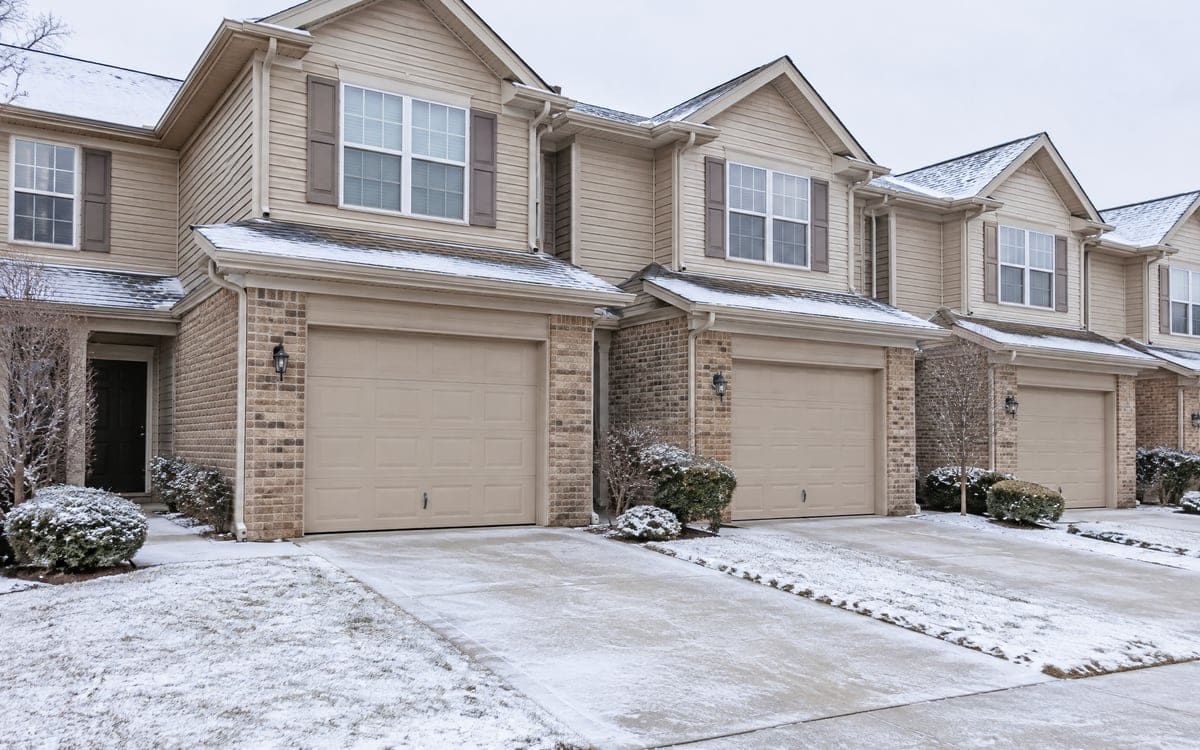
About 12 percent of the village's housing units were built in 2000 or later, including a small number of newer units. A newer garage usually has a modern opener with photo-eye sensors and a steel door with an insulated core. The service calls shift: bottom seals on a cul-de-sac driveway are worth checking, and the long opener life means a sensor fault is more likely than a dead gear. On a townhome in a newer subdivision, the sensors and the opener may be matched, which can change how we price a repair versus a replacement. A homeowner on a house that recently changed hands often has no history on the hardware, so the first visit is where we build the picture.
Services for this housing
Springs on older houses have had the longest to wear, and northern Illinois averages 140 days a year at or below 32 degrees F. A yearly check before the cold catches the tired ones before the first cold morning finishes them. On a two-spring door, matched replacement is usually the right call so one new spring is not pulling against one tired one.
Cables and bottom brackets wear from the salt that plows and tires carry. The bottom bracket holds the end of the lift cable and sits under full tension when the door is closed, so a rusted one is a safety call rather than a cosmetic fix. On a newer garage, a reversing-door call is more often a sensor out of line than a worn mechanical part, and an opener with no photo eyes at all is old enough to replace rather than patch.
Bottom seals wear faster where plow slush gathers at the end of a driveway, and on a village with more than 360 cul-de-sacs that covers a lot of houses. A fresh bottom seal and a threshold strip take most of that abuse out of the equation. When the time comes for a new door, the right choice depends on how the garage is used, not only on how it looks from the street.
Townhomes and associations
About 15 percent of the village's housing is single-family attached. On a townhome, the garage door is often an owner responsibility while color, style and sometimes window layout fall under the association's rules. Before we quote a replacement on a townhome, ask the association what the rulebook says: approved colors, approved window grids, approved panel styles. We will quote to whatever spec the association has approved. Repairs to springs, cables, rollers, sensors and the opener usually sit cleanly on the owner side and need no association sign-off, since none of them changes how the door looks from the street.
Landmarks people give for directions
Village Hall is at 1900 Hassell Road, which is also where the Development Services Department sits. NOW Arena is at 5333 Prairie Stone Parkway. The Forest Preserves' 1,800-acre Paul Douglas Preserve has 25 miles of trails on W Central Ave east of Huntington Boulevard. The Village has an adopted Western Area Plan from April 2019 and a Hello Hoffman comprehensive plan update underway.