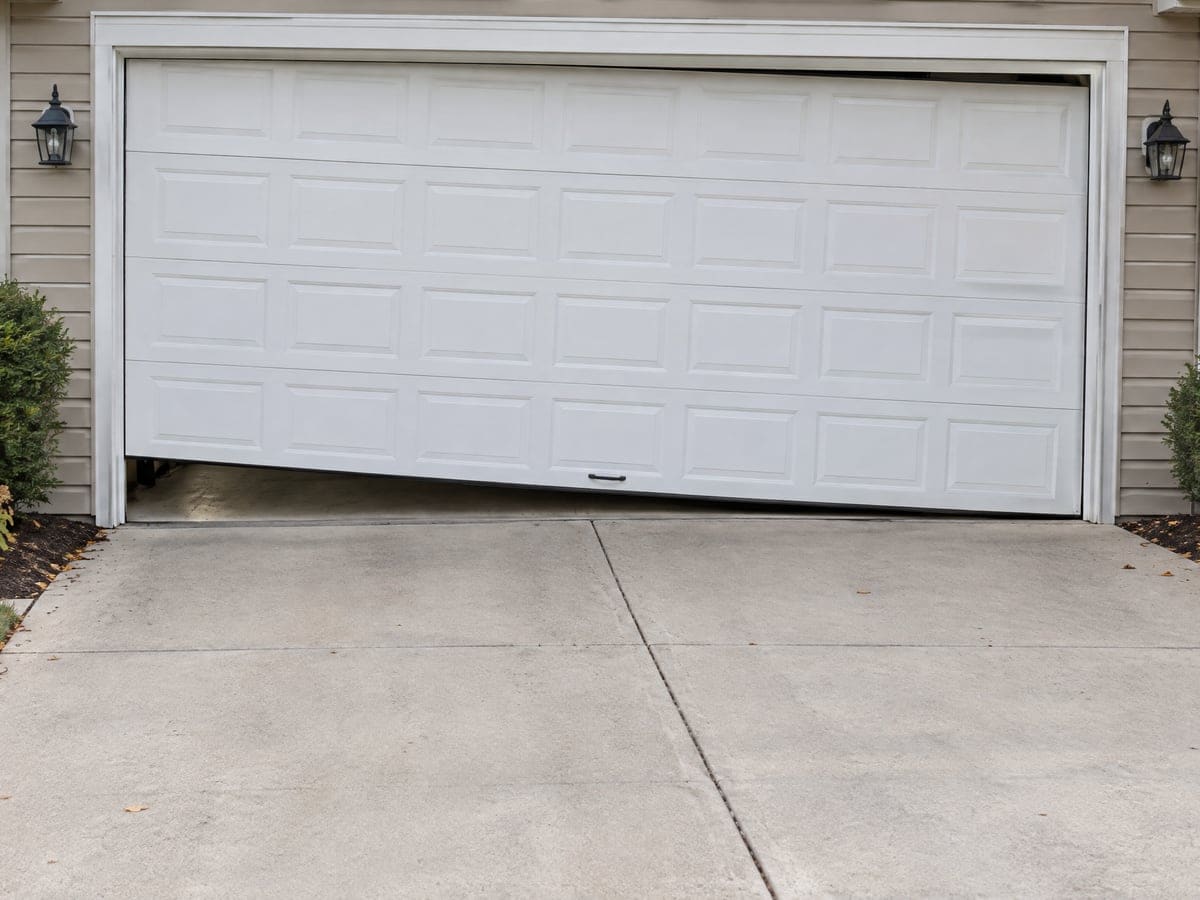
What to do right now
A door off its rollers is heavy and awkward, with cables that may be loaded in ways you cannot see from the ground. Each extra press of the button can snap a cable or crease another section.
1. Stop using the opener
Put the remote and the wall button down. Running the opener on an off-track door drags sections into the opening at angles the hardware was never meant to carry, and often snaps a cable or bends a track that was fine until the next press.
2. Turn off the garage breaker
Turn off the breaker for the garage at the house panel. Do not reach for the opener or its cord, and do not use a step or ladder near the door. The breaker is the one safe way to cut power to a hanging door.
3. Keep clear of the door
Nobody walks under the door, nobody drives in or out, and the car in the driveway stays where it is. Pets and children go into the house through a different door. A section that is holding by one roller and a bit of friction can let go with no warning.
4. Leave the emergency release alone
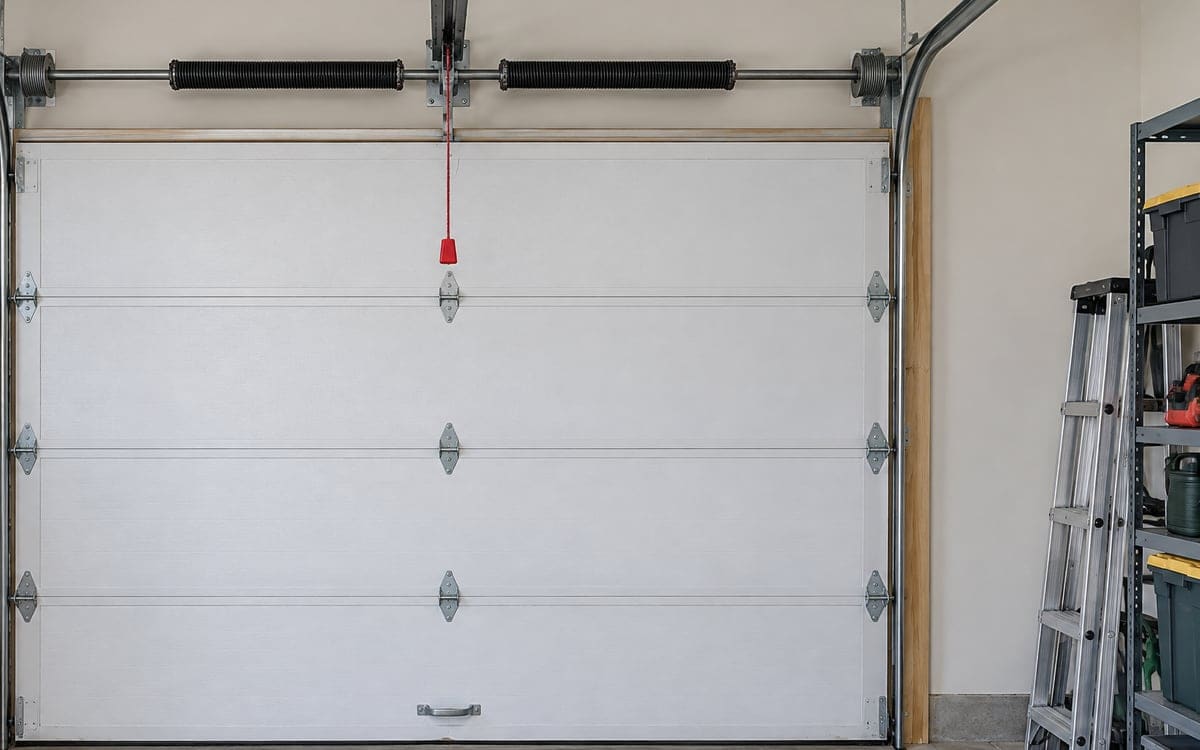
Leave the red emergency release cord alone. Pulling it on a door that is off its rollers or hanging crooked drops the door's weight onto whatever is still holding it. We work the release at the visit, with the door supported.
5. From a safe spot, see what happened
From inside the garage, standing well clear, look at which side came out and where. Is a bottom roller out? A top one? Is a cable hanging loose? Is a section cocked at the top or the bottom? That tells us what to bring and sometimes shortens the visit by one trip.
6. Call
Call us and tell us what you see. If a car is in the garage and you need in, say so; we handle that at the visit without using the opener.
Why doors come off their tracks
A door that was running fine does not jump the track on its own. One of a handful of things usually started it.
The commonest culprit is a car bump nobody wanted to admit to. Even a slow nudge against a vertical track pushes the track out of plumb at the top, and the next time the door closes, a roller finds nothing to run in.
A broken cable can let the door drop to one side. A cable that frayed through, often at the bottom bracket, lets one corner down fast; the opposite corner finds the track at a bad angle and comes out at the top.
Worn rollers that no longer sit straight in the track are another regular cause. A cracked nylon wheel or a bent stem lets the roller lean, and over time the lean becomes a jump.
Watch too for a loose jamb bracket that has let the track creep out from the wall over months. The track leans away from the door at the top, and the first time a roller catches the lip, it is out.
Winter adds its own version: a bottom seal frozen to the slab while the opener keeps pulling against it. A door stuck to the floor in a January freeze that the opener keeps trying to open ends with a creased section or a jumped roller.
Then there is a broken torsion spring that lets the door come down hard. The sudden weight on an opener that cannot hold it, or on a cable that gives, can jerk the door out of its track in one event.
| Symptom | Likely cause | What it usually needs |
|---|---|---|
| One side of the door lower than the other | A snapped cable or a loose cable off its drum | Reset, new cable, spring and drum inspection |
| Top rollers out of the horizontal track | A loose track hanger or a car bump at the top | Reset, new rollers, often track work |
| Door jammed half open, sections tilted | Opener forcing on an off-track or cold-stuck door | Spring and hardware inspection before reset |
| Slack cable on one side | A dropped side, a broken spring, or a cable off the drum | Reset, likely new cables, spring check |
| Rollers out at the bottom corner | A worn bottom roller or a bent bottom bracket | New rollers, new bottom bracket if bent |
| A whole section pushed in at the opening | A car bump while the door was moving | Reset, new section if creased, full door inspection |
Reset the door or replace parts
A reset puts the door back in the track, settles the cables on the drums, and tightens the hardware. Replacement comes in when the reset by itself will not hold.
When a reset holds
- The track is straight and still bolted square to the jamb
- The cables are intact, the drums unbent, the bottom brackets sound
- The sections took no damage worth replacing
- The springs are intact and the door balances when lifted by hand
When parts need to go in
- The track is bent, bowed or kinked where the door jumped
- A cable is frayed or broken
- A roller is cracked or its stem is bent
- A bottom bracket has twisted
- A section is creased or the hinges along it are bent
How we tell at the door: with the door supported and the opener disconnected, the technician lifts it a few inches, watches each roller cross the curve, and sights down each track. A reset that will hold rolls clean through the curves on both sides.
What our technicians bring on an off-track call
Our vans usually carry replacement rollers in nylon and steel, a selection of lift cables and drums, hinges, bottom brackets, track sections for common openings, and the clamps, winding bars and ratchet straps for supporting the door while we work. On a door with a creased section, the fit visit comes after the section is ordered to the model.