Mice follow warmth into attached garages in fall
An attached garage is a sheltered box next to a heated house, so it is a few degrees warmer than the yard and a lot drier than a shed. In Hoffman Estates, 11,626 of the village's 19,335 housing units, about 60 percent, are single-family detached homes, and another 2,833, about 15 percent, are single-family attached homes.1 On any of those homes with an attached garage, a mouse that reaches the garage is a wall away from the kitchen or laundry room.
For that reason, closing the garage door's gaps is the first move and tightening the inside door is the next one.
The bottom seal gap is the main way in
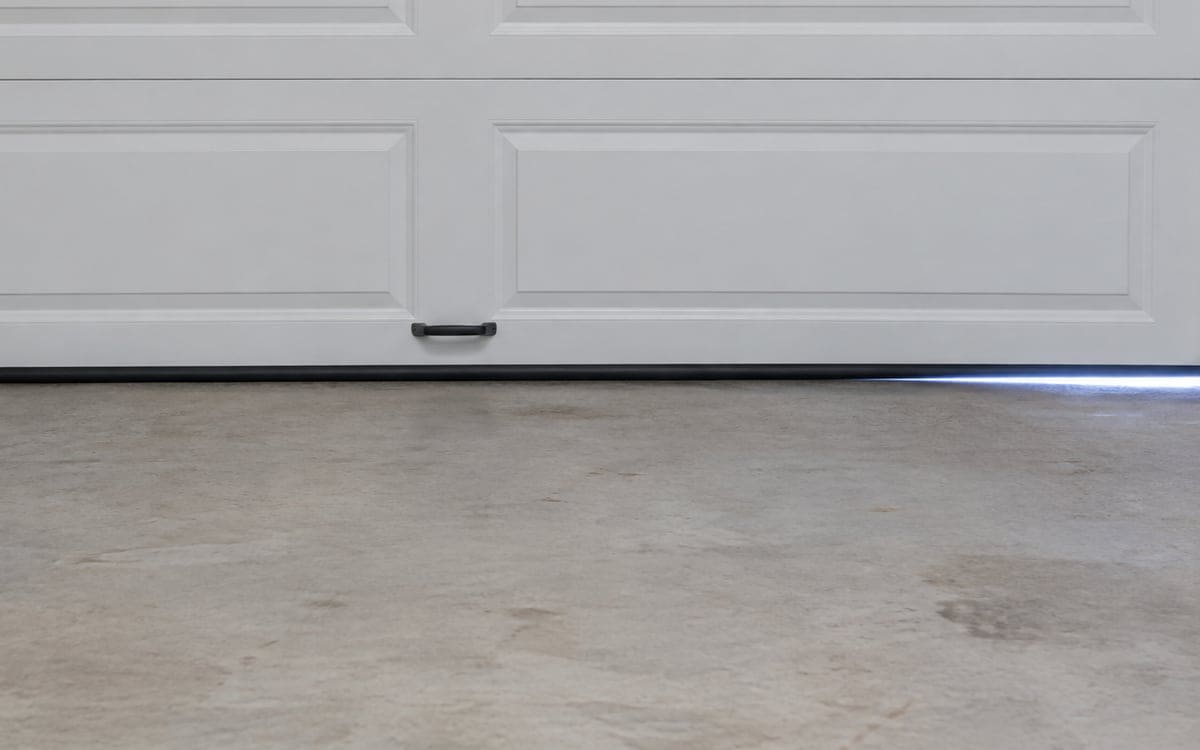
The rubber strip along the bottom of the door is the main barrier at the floor. When the seal is new, it squashes flat against the slab and the door closes with no light at the corners. When the seal is worn, it keeps shape in the middle and lifts at the corners, where the slab is often not perfectly level. Mice can slip through a surprisingly narrow gap, and a worn bottom seal often leaves more than enough space at a corner.
To check from outside: close the door on a bright afternoon and step back to the driveway. Any line of daylight showing under the door, especially at the two bottom corners, is a gap. From inside, with the door closed, look at the inside face of the bulb. The rubber should look flat along its length. A seal that is torn, hardened, set in a flat shape, or showing daylight at the corners has lost its squash and is due for a new bottom seal.
The first freeze around Hoffman Estates sends them looking
The animal pressure peaks in fall for a simple reason: it gets cold. The normal first autumn temperature of 32 degrees or lower at O'Hare comes on October 19, based on 1991 to 2020 data.2 That is the normal, not the earliest. The weeks around that date are when mice are at their most determined to find a warmer room.
The practical window to close the door's gaps is late September through mid October. Fall, while the garage is dry and clean, is the easier time to have the seal replaced.
Corners, side stops and the retainer
The bottom seal is only one piece of the perimeter. Side stops are the vertical wood or vinyl strips mounted to each side jamb that press a flexible flap against the face of the door. A top stop runs across the lintel above the door and does the same job up top. When the stops are tight and square, the door closes into a sealed box. When they are warped, cracked or pulled out from the jamb, there is a vertical slit a mouse can walk through.
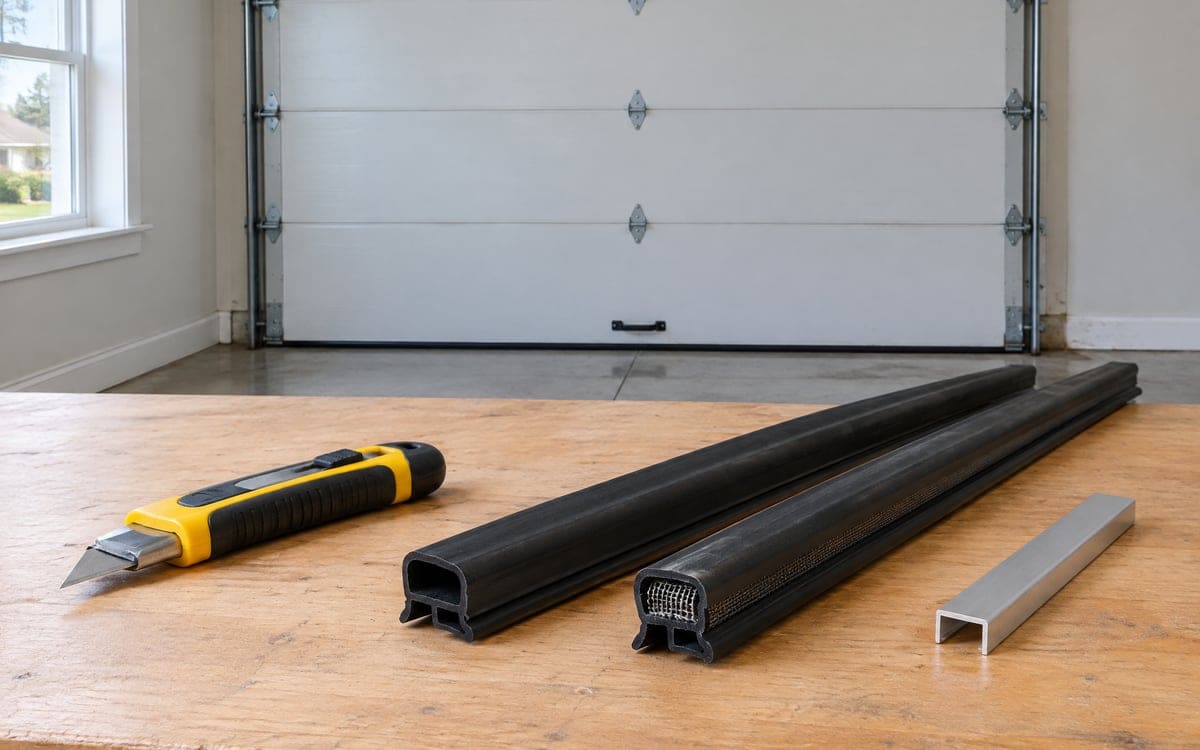
The retainer is the aluminum or steel channel on the bottom edge of the door that holds the bottom seal in place. On a steel door, the retainer is screwed or crimped into the lower section. If the retainer has pulled away from the door at a corner, the seal lifts off the slab and the gap starts there. A new strip rolled into a retainer that is bent out of true will not solve the problem; the retainer gets replaced too.
Rodent-resistant seals and what they add
A rodent-resistant seal is a bottom seal with harder material built into the bulb, often along the leading edge the mouse would try to chew through. Some are a two-piece design that places a stiffer insert inside a soft rubber bulb. The harder material is there to make the first chew unrewarding. A mouse chews a lot of things and moves on when a chew does not deliver a hole.
A rodent-resistant seal is a soft gasket with a tougher bite line, and it still has to meet a sound slab through a straight retainer. The place it earns is a door that mice have already found. A rodent proof garage door seal is the swap for a seal that has been chewed through once already, and it fits the same retainer as a standard seal in most cases.
Perimeter flaps with a stiffer leading edge are also available for the side and top stops; in every case the retainer or the stop molding carries the weather strip, and the strip itself is the chewable part.
Keeping the door into the house tight
The second door, the one that goes from the garage into the house, is the one that keeps mice out of the kitchen even if a few have made it as far as the garage. On an attached garage, that door is often behind a laundry room or a mud room. For mice, the parts that matter are the sweep at the bottom and the weather strip around the frame.
Check the sweep on the garage side of that door with the door closed. A flat palm run along the floor at the bottom of the door should feel the sweep. If it does not, the sweep is worn or missing. Check the weather strip around the frame for daylight.
The door and its perimeter are what a garage door service handles. For how the attic ties back to winter heat, see attached garage insulation.
A once-a-fall perimeter check at the garage door
The perimeter walks in two passes. Close the door on a bright afternoon. Walk the outside first and look at the bottom corners, then the vertical joints where the stops meet the slab, then the top where the lintel seal sits. From inside, walk the perimeter again with the garage lights off and the overhead door closed. Any light coming through from outside is a gap.
| Where to look | What a gap looks like | What usually closes it |
|---|---|---|
| The bottom corners of the door | Light under the corners when closed | A new seal and, often, a straight retainer |
| The vertical joints at the floor | Light where the side stop meets the slab | A new section of stop molding at the base |
| The lintel seal above the door | Light along the top of the door inside | A new top seal strip |
| The seam between the retainer and the door | A thin line of daylight along the bottom edge | Reseating or replacing the retainer |
| The door into the house | Floor sweep not touching, light around the frame | New door sweep and frame weather strip |
A monthly look at the door from a safe distance catches the perimeter signs between visits.
When to call for a new seal or a tune-up
Three signs point to a visit rather than a product off the shelf. The first is light at the corners that stays after the seal is replaced. That is usually a retainer problem, sometimes a slab that has settled, and sometimes a lower section that has bowed. The second is chew marks on the bottom edge of the door or the retainer. A chewed seal gets a rodent-resistant replacement; a chewed retainer gets a new retainer with the seal; a bowed or damaged lower section is the case for a panel replacement look. The third is side stops that have warped or pulled away from the jamb and do not close on the door's face.
For a service visit that covers the perimeter and the hardware together, a fall tune-up is the common pairing. The technician checks the seal, the retainer, the stops and the hardware above the door, then lists what it needs.