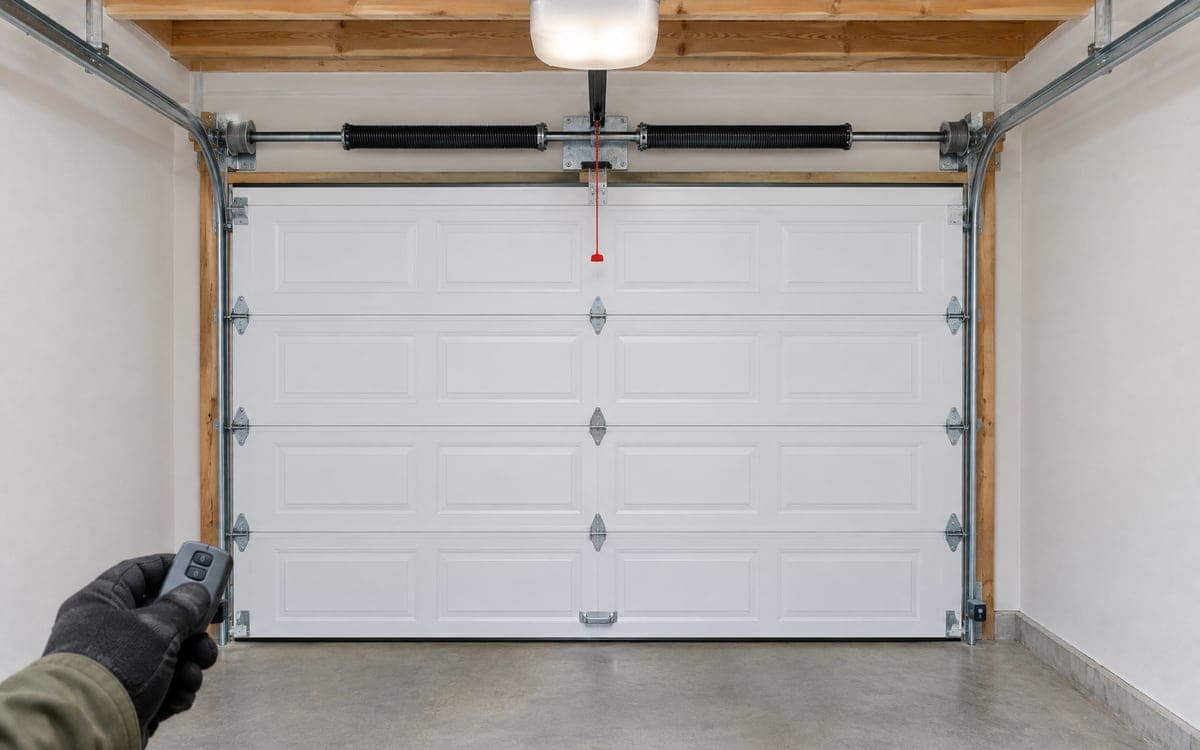
The garage door opener learn button and what it does
On most openers from the last twenty-plus years, somewhere on the back or side of the motor head there is a small button and an indicator light. The button is often labeled with a word about learning or memorizing. That is the pairing button. The opener listens for a short window, usually about thirty seconds, and whatever remote or keypad talks to it in that window gets added to memory.
On older openers the color of the light tells the frequency the opener uses, and that color decides which accessories will pair. On the newest ones a short press and a long press do different things, with the long press used to wipe memory.
The learn button sits on the motor head on the ceiling, which puts it out of reach from the garage floor. Pairing at the motor head is a technician's job on the visit; the floor-level checks (the wall button, the lock switch, the remote battery) are the ones a homeowner can safely run.
How a garage door opener remote pairs
The remote is the first pairing most people need. On the visit the technician works at the motor head: one press of the pairing button, the indicator light comes on, the remote button is pressed within the listening window, and the light blinks or goes out when the remote is paired.
A single opener holds a limited number of remote codes. If a new remote will not pair, the memory may be full, and the next section covers how a wipe works.
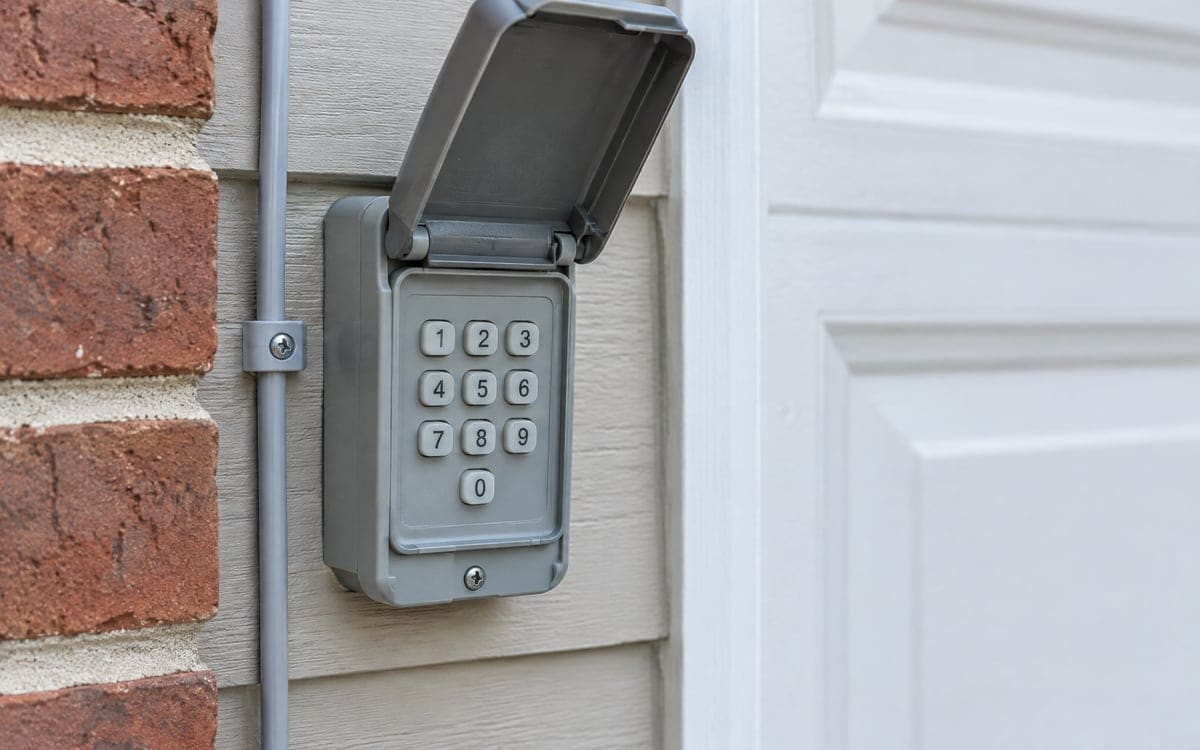
Adding a wireless keypad after the remote
A wireless keypad on the outside of the garage uses the same pairing process. The homeowner picks a four to six digit code; the technician pairs the keypad at the motor head to that code.
A keypad only works when the opener and the keypad speak the same frequency. If the opener is old and the keypad is new, the pairing simply does not take. That is one of the signs that the opener itself is the limiting part.
Clearing every code after you move in
After buying a house, the first job is clearing the opener's memory. There is no way to see the list of codes that are currently paired, and there is no telling who still carries a working remote: the former owners, their contractor, the painter who was given one for a week last summer. Wiping memory kicks everyone out.
The wipe is a long press on the pairing button at the motor head, held until the indicator light goes out, where a short press would pair a new remote and a long press clears the memory. The wipe is a technician's job on the visit, with the door closed and still; the remotes and keypad are then paired fresh.
Clearing memory is also the fix when a remote stops working after a new one is added. Memory may be full, and wiping it lets the active remotes be paired fresh.
Frequencies have to match the opener
Openers made since the 1990s use rolling codes that change every press. Older openers used fixed codes with small switches inside the remote. The two are not compatible, which is why a new remote off a store shelf will not work on an opener from the early nineties, even when the pairing steps seem to go through.
If the opener and remote use different frequency bands, no amount of pairing will fix that either. The opener has one radio and the remote has one radio, and the two radios have to tune to the same place. Replacement remotes are usually sold by compatibility with the opener's radio, so matching the opener's receiver color or model generation at the parts counter is the right first step.
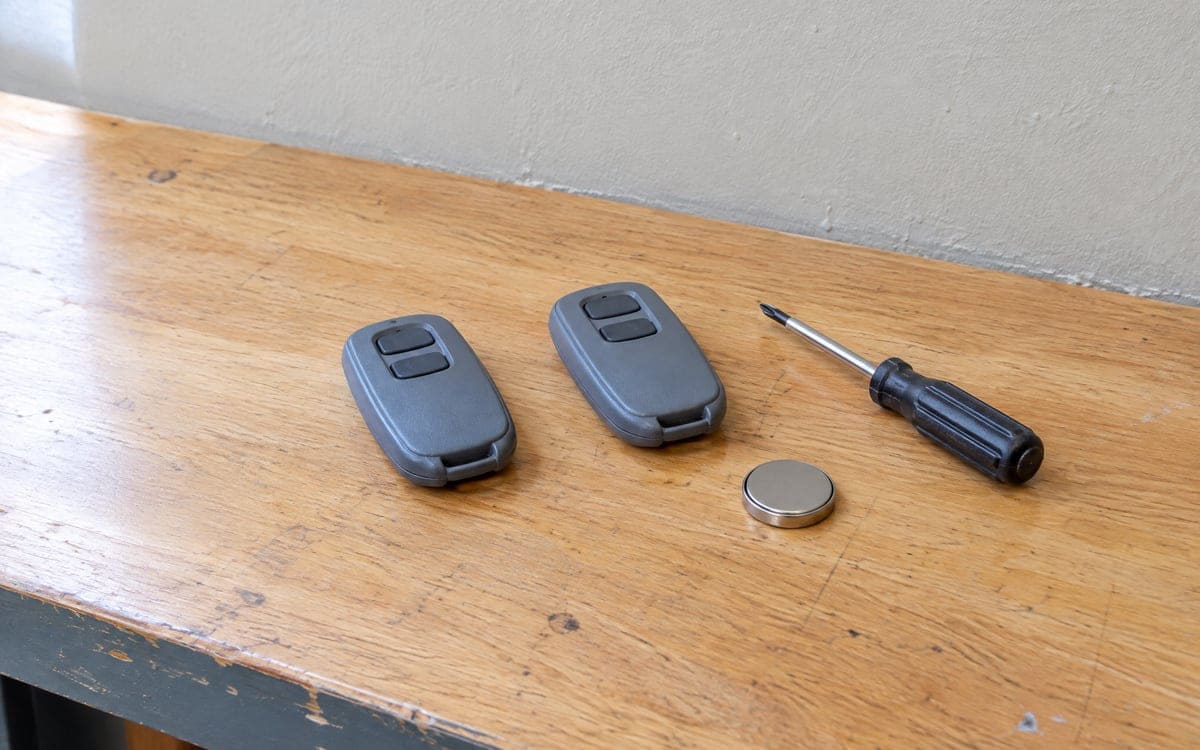
Older openers in 1970s garages will not take newer remotes
Hoffman Estates has a lot of garages that were built with the house in the 1970s, the single largest decade of the village's housing.1 The opener on an older garage has often been replaced once or twice since, but not always. If the motor head on the ceiling looks dusty and uses incandescent bulbs and the housing is painted metal rather than molded plastic, the opener itself may be old enough to pre-date rolling codes and lack the photo-eye sensors near the floor and the auto-reverse that newer motor heads bring.
An opener that old is worth replacing rather than nursing. A new opener comes with a new remote and keypad, and the homeowner is pairing from scratch anyway. Our new opener installation swaps the motor head, the rail, the safety sensors and the wall button, and the pairing goes in before the technician leaves.
When the receiver or logic board is the fault
Sometimes the pairing goes right and the opener still ignores the remote. Before chasing the opener, look at the wall control inside the garage. Many wall controls have a lock switch that turns off every remote and keypad while leaving the wall button alive. A lock switched on by accident is worth ruling out first. If the lock switch is clear and remotes still ignore the opener, the next two causes are:
- The receiver, which is the radio inside the motor head, has gone deaf. Replacement of the receiver module solves it on openers that have the part separate.
- The logic board, which is the main circuit board, has failed. The pairing button and indicator light are both on that board, and when it goes, nothing paired reliably works. A new board, or a new opener, is the fix.
A storm with a close lightning strike can take out either part, and so can a surge from the house's electrical panel. Our garage door opener repair covers both parts, with the door's balance set in during the work so the new electronics are not sent back out to fight an unbalanced door.
| Problem | What usually explains it | What tends to fix it |
|---|---|---|
| New remote will not pair | Memory full, wrong frequency | Clear memory, confirm compatibility |
| Keypad takes code but door ignores | Keypad and opener different generation | Match the keypad to the opener |
| Remote worked, now does nothing | Dead coin cell, cold battery | New battery, warm it up |
| Nothing paired works, wall button works | Lock switch on, then receiver module | Flip the lock switch off; if remotes still dead, replace receiver or opener |
| Nothing works at all | Logic board, power | Service call |
Range problems look like a programming fault
A remote that works near the door and stops working from the driveway is not a pairing problem. It is a range problem, usually a weak battery, a bent antenna wire hanging from the motor head, or interference from a new wireless device nearby. The antenna is the thin wire that drops down from the opener housing. Look up from the floor and see if the wire is still hanging straight; if it is tucked up out of sight or looks broken, mention it when you call so we can address it on the visit.
Our monthly door safety checklist covers the checks the homeowner does from the garage floor, including the wall button, the lock switch and the look at the remote antenna.