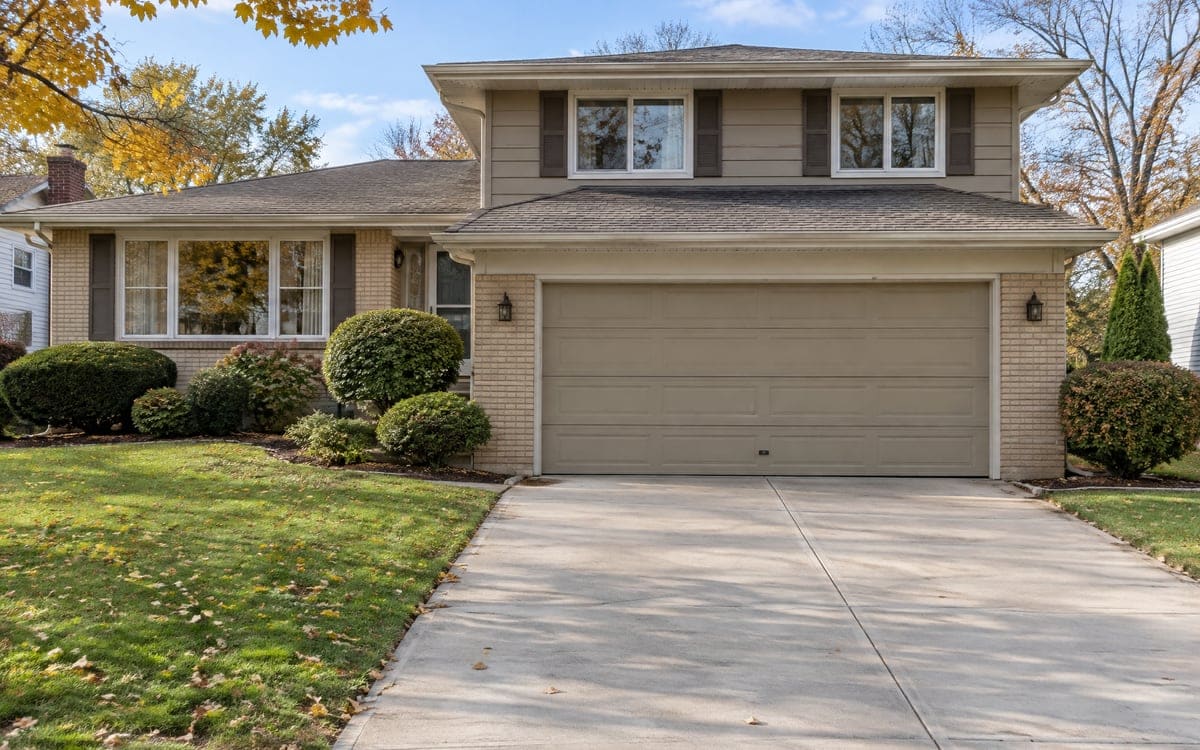
Many 1970s doors were built with extension springs
Extension springs sit above the horizontal tracks on either side of the ceiling. On each side, a lift cable runs from the bottom bracket at the corner of the door up to a fixed pulley near the front of the horizontal track, back along the track to a second pulley that rides on the front end of the extension spring, and forward again to an anchor near the front of the track. The back end of the spring hooks to the rear track hanger. A separate safety cable, which is a straight wire inside the coils, runs through the spring from end to end.
When the door closes, the spring stretches. When the door opens, the stretched spring pulls back on the pulley at its end, which shortens the cable loop and lifts the door.
About 33 percent of the village's housing was built in the 1970s,1 the largest share of any decade, and the 1960s and 1970s together make up about 52 percent.1
The parts of an extension spring garage door
An extension system has more hardware along the ceiling than a torsion door. On each side of the opening the parts are the extension spring, a lift cable, a safety cable through the spring, the fixed pulley near the front of the horizontal track, and the pulley riding on the front end of the spring. The lift cable and the spring are under load any time the door is closed.
Torsion doors have one or two springs wound onto a steel shaft above the opening. Short cables run from the bottom brackets up to small drums at each end of the shaft. The shaft turns, the drums wind the cables, and the door lifts. The torsion door has fewer moving parts along the ceiling, and its balance is set by how many turns the spring is wound.
Torsion springs are quieter and easier to balance
A door on torsion springs usually runs quieter than one on extension springs because fewer parts are bouncing and swinging up near the ceiling. A torsion spring also lets a technician set the balance in small, measured turns, so the door can be tuned to lift evenly.
Extension springs balance by matched pairs. If one side gets weaker than the other, the door starts to hang crooked. The hardware along the top makes a louder visit of it too, with a sharp bang the loudest of the sounds a worn setup makes when the door bottoms out.
What a conversion changes above the ceiling
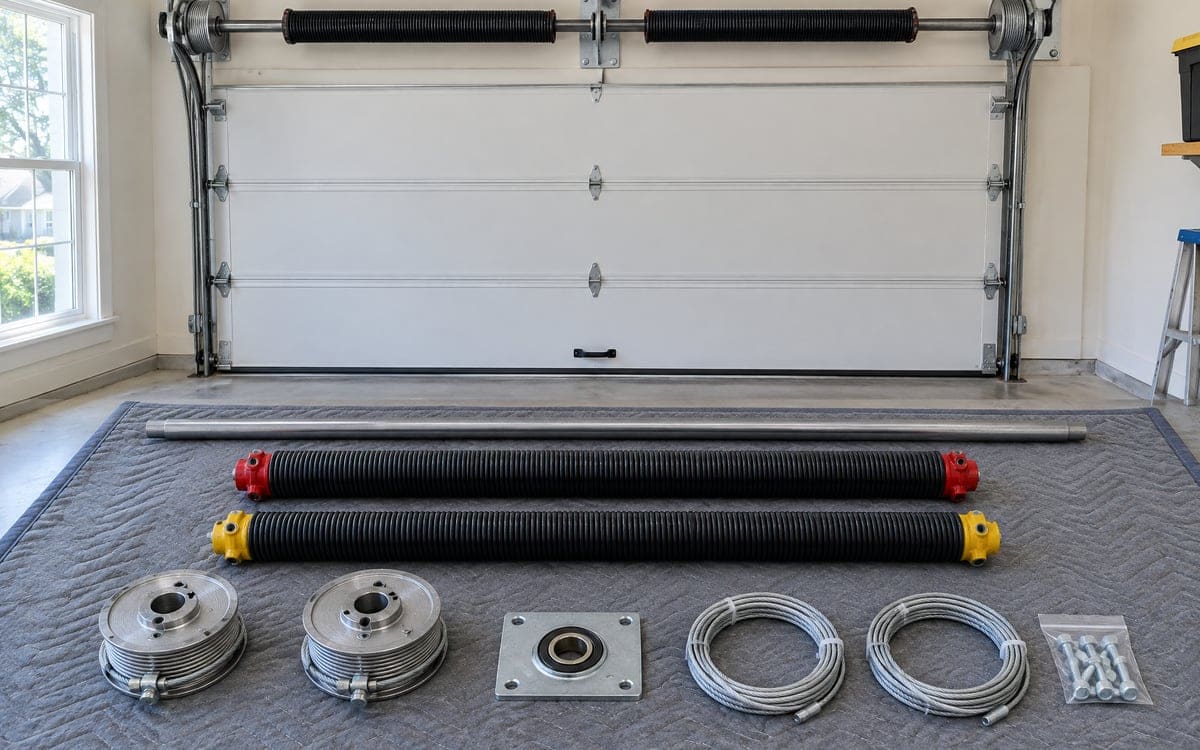
A conversion swaps the two extension springs, the pulleys, and the long cables for a torsion shaft, two cable drums, a center bearing plate, two short lift cables, and one or two torsion springs sized to the door's weight. The ceiling clears up. The cables shorten to the height of the opening instead of running the length of the horizontal tracks. The old pulleys and the long cables come down.
The bottom brackets are also replaced with the tamper-resistant style that is standard with a torsion setup. Those brackets stay on the door and should never be loosened by a homeowner, since they anchor the cable under spring tension.
When keeping extension springs is fine
Not every door needs to be converted. Keep the extension setup when:
- The current springs are matched, in good condition, and the door balances right.
- The hardware above the tracks is quiet and the pulleys spin freely.
- The door has safety cables running through the springs.
- The door is not scheduled for replacement in the next few years, since a new door usually comes with a torsion kit by default.
If the only issue is a worn pulley or a frayed cable, a simple cable and drum repair keeps the system you already have. We will say so at the visit if that is the better call.
Safety cables matter either way
If the door has extension springs and no safety cables, that is the first thing to add, converted or not. A safety cable threads through each extension spring and anchors at both ends of the track. When a spring snaps, the cable catches the broken halves so they do not swing across the garage. On an older door that still has the original hardware, there is a fair chance the safety cables were never installed.
Signs an extension spring is near the end
Extension springs give some warning before they fail. Watch for:
- A gap in the coil, usually a few inches long, where the metal looks parted.
- Rust that spreads along a stretch of coil, deeper than surface flecks.
- A door that hangs down an inch or two on one side when closed, with cables that look uneven in tension.
- A sharp bang or ping heard from the garage with nobody in it. Often the sign that one spring has let go.
Any of those is a reason to call rather than wait.
| Symptom | What it usually means | What we usually do |
|---|---|---|
| Door hangs crooked when closed | A pair that is no longer matched | Replace both springs together |
| Loud bang from the garage | One extension spring broken | Replace both springs, add safety cables if missing |
| Door hard to lift, opener strains | Springs weak, out of balance | Measure the door and set new springs to its weight |
| Pulley squeaks or sticks | Worn sheave, dry bearing | Replace the pulleys with the cable |
| Frayed strand on a cable | Cable at end of life | New cables, matched pair |
Prices for any of these jobs depend on the door's weight and height and on what else needs new parts.
What drives the price of a conversion
A few things move the price:
- Door weight. A heavier insulated steel door needs stronger springs and a larger shaft.
- Door height. A seven foot door and an eight foot door use different drums.
- One or two springs after conversion. Many single-car doors run fine on one torsion spring. Most double-car doors use two.
- Bottom brackets, rollers and hinges. Replacing tired ones along with the conversion avoids paying for the work twice.
- Headroom above the opening. Low headroom calls for a different shaft setup.
The visit, when a conversion makes sense
What a conversion visit covers:
- The door is measured and weighed against the frame, and the opening height and headroom are checked.
- The parts that match the door are laid out: one spring or two, the right shaft length, the right drum size.
- A price for the shaft, springs, drums, cables and labor.
- The extension hardware comes down, the torsion shaft and springs go up, new cables are run, and the balance is set.
A tune-up on an older door can catch the drift before a spring parts. A garage door tune-up tightens hardware, lubricates the right spots, checks the balance and marks the parts that are headed for replacement.
A spring job is never a weekend project
Both systems hold the door's weight under load. A spring assembly, a bottom bracket under cable tension and a ladder near a wound spring are all technician work, not weekend work.
Leave both ends alone and have the work done. For a stuck door that bangs or will not lift after a spring lets go, broken spring repair is where to go, and emergency garage door repair covers a spring that snaps with the car inside. The problems that come with cold weather and springs are worth a read before the coldest weeks, and what a 1960s or 1970s Hoffman Estates house means for its door runs through the rest of the aging hardware.