What is wrong with the door?
The order below is the one we work in at the house. It is not a list of things to do yourself.
1. A look at the closed door with the opener unplugged
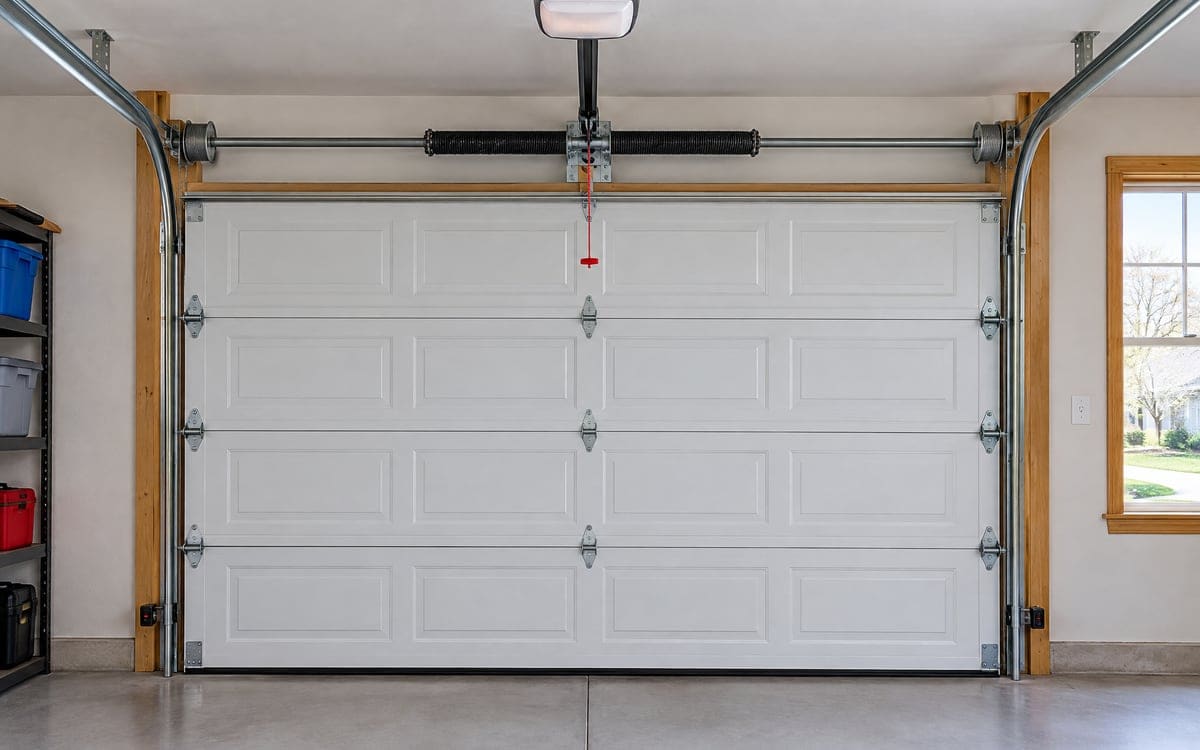
The technician starts inside with the door down and the opener disconnected at the ceiling outlet. The spring holds its highest load when the door is closed, so most of the signs are visible without the door moving: how the door sits in the opening, whether a cable is slack, and whether there is a gap in the spring coil above the door.
2. Springs and the shaft above the door
Torsion springs sit on a shaft across the header. A broken one has a clean gap in the coil, often a hand's width or more. Extension springs run along the horizontal tracks with safety cables threaded through them; a broken extension lets the cables go slack. The technician reads which pattern the door uses and sizes the replacement to the door's weight.
3. Cables and drums
Lift cables carry the spring's lift to the bottom corners, so they are under full tension with the door closed. We check for strands fraying at the bottom bracket, rust at the floor where road salt collects, kinks from an off-track door, and loose wraps on the drum. Lift cables and drums covers the chain of parts that fails together.
4. Rollers and hinges
Every roller sits in its track and every hinge carries a share of the weight. We check each roller for a flat spot, a cracked wheel or a bent stem, and the hinges for cracks and loose screws. Nylon rollers have steel stems and bearings that rust from the inside after a few winters of apron slush. Worn rollers and hinges is the usual fix on a door that has started to grind.
5. Tracks and brackets
We sight each vertical track for dents and loose jamb brackets, and each horizontal track for sag at the rear hanger. A track that has moved a quarter of an inch in a bracket is enough to bind a roller halfway up. Bent or loose track covers what we straighten, realign and replace.
6. Sections, bottom seal and weather stripping
Section by section, we look for cracks at the end stiles and splits along the hinge line, then run a finger along the T-shaped rubber at the floor for tears and flat spots. On a door that still runs but no longer seals, a torn bottom seal is the quick fix.
7. Opener, rail and photo-eye sensors
At the opener head we test power, the lock switch on the wall control (which disables remotes and keypads while the wall button keeps working), the wall button, and the sound the motor makes. We check the rail for trolley position and belt tension, and the photo eyes for alignment, blocked lenses and loose wire. Opener trouble and photo-eye sensors have the fuller checks.
8. The balance check
The technician disconnects the opener at the trolley, raises the door to the halfway point, and lets go. A door balanced to its springs holds there. A door that drops has weakened springs; one that climbs is overwound. The balance check is a technician's job because the door is under spring load throughout.
9. The reversal check
We lay a two-by-four flat on the floor under the door and close with the opener. The down force should reverse the door when it meets the wood. A door that keeps closing has its down force set too high. A door that reverses as it touches the floor usually has its down limit set too far or its close force set too sensitive.
The symptom table
| Symptom | Likely cause | What it usually needs |
|---|---|---|
| Loud bang, then the door will not lift | Broken torsion or extension spring | Spring replacement |
| One side rises first, slack where a cable should be tight | Cable off its drum or frayed | Cable replacement |
| Grinding or shuddering on every pass | Flat spots on rollers, worn bearings | Full set of new rollers |
| Door catches at the same spot every time | Dented or misaligned vertical track | Straighten and realign the track |
| Door reverses partway down | Blocked or misaligned photo-eye sensor | Sensor repair or alignment |
| Door reverses as it touches the floor | Down limit set too far or close force too sensitive | Opener settings reset |
| Opener hums, door does not move | Broken spring; the opener is trying to lift a door the spring was holding | Spring replacement, then recheck the opener |
| Light along the floor through the closed door | Worn bottom seal or torn stop molding | Bottom seal replacement |
| Door closes fine but is loud at the hinges | Dry hinges, loose track bolts, aging hardware | Tune-up and lubrication |
Repair or replace
Repair is almost always the first option on a sound door with one broken part. A new door earns its place in a short list of cases: sections cracked through on more than one panel, a model so old that matching sections and hinge sets are no longer made, a door that has shifted on its mounts enough that the tracks will no longer true up, or a repair list long enough that the money is better spent on a new door. When a new door makes more sense is the checklist we read in front of you before any price is quoted.
What a technician brings
A technician usually carries the parts that fail most often: torsion springs in common wind and inch counts, extension springs in a short range of lengths, lift cables cut to common heights, nylon and steel rollers, bottom brackets, drums, safety cables, hinge sets, bottom seals, photo-eye sensors, basic remotes and keypads, and the winding bars that spring work needs. Not every size for every door lives on the van; a door with an unusual spring may need a return visit.